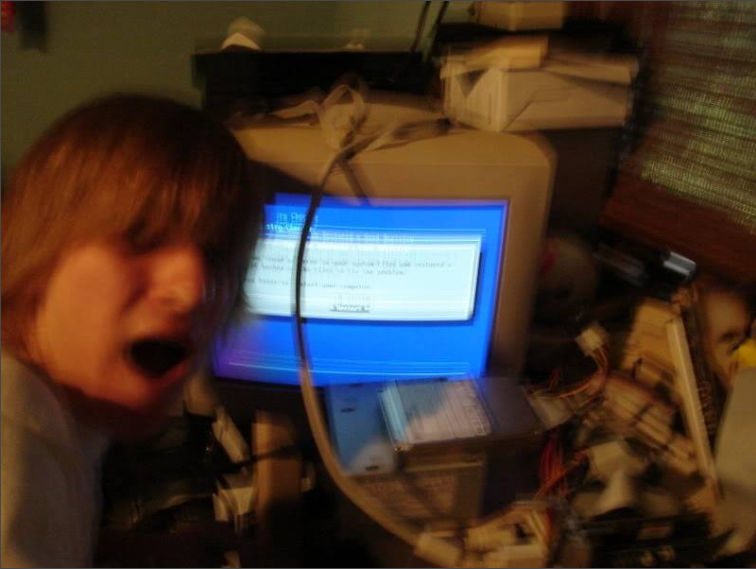
While my haircut should be illegal in this photo, it’s the grainy screen in the background is what is becoming increasingly illegal here in the United States.
This is me. Somewhere around 14 years old, hunched over a desk covered in screws, cables, and whatever else I could scrounge. The picture is grainy. The desk (and my hair) is a mess. But the feeling I had in that moment was very real: I just built a working computer from parts I picked out of a dump, and I finally managed to boot Damn Small Linux on it.
No one asked me for my ID. No one verified my age. No one told me I needed parental consent to boot an open source operating system.
It was the beginning of a thrill that started my lifelong incessant interest in all things computers.
5 states and counting
As of 2026, five US states have passed laws requiring age verification at the operating system level — not just for apps or websites, but for the OS itself:
- California (AB 1043) — effective January 1, 2027. Requires all operating systems, including Linux, to collect a user’s birth date or age during account setup.
- Colorado (SB 26-051) — penalties beginning in 2028. Requires OS providers to collect and store age brackets and share this data with app stores.
- Louisiana (HB 570) — effective July 1, 2026.
- Illinois (SB 3977) — effective January 1, 2027.
- Utah (SB 142) — some provisions already active, with more activating throughout the year.
New York has a bill proposed (S8102A) that goes even further, explicitly forbidding self-reporting and leaving allowed verification methods up to the Attorney General. More states will follow.
These laws assume that every operating system has an account creation flow where age can be neatly verified. That might be true for Windows, macOS, iOS, and Android. But it is absolutely not true for Linux, BSD, or the hundreds of other open source operating systems that power much of the world’s infrastructure.
You can’t card a kernel
Here’s where these laws fall apart entirely: open source operating systems.
Arch Linux doesn’t have an account creation wizard. Gentoo compiles from source. Damn Small Linux fits on a business card-sized CD. There is no “sign up” flow. There is no corporation to serve a subpoena to. The author of your favorite distro might be a pseudonymous contributor in another country.
How do you enforce age verification on software that anyone can download, modify, compile, and distribute? Who is liable — the person who wrote the bootloader? The volunteer who maintains the package mirror? The kid who burns the ISO to a USB stick?
These laws betray a fundamental misunderstanding of how software works. They were written with Apple and Microsoft in mind, and open source got caught in the crossfire.
Gatekeeping curiosity
But the technical infeasibility isn’t even what bothers me the most. What bothers me is the message these laws send to the next generation.
When I dragged those computer parts home from the dump, I wasn’t doing anything dangerous. I was learning. I was problem-solving. I was building something real with my hands and my brain, completely unsupervised, completely self-directed. Nobody curated that experience for me, and that’s exactly why it worked.
That moment of raw, unsupervised exploration — pulling a computer out of the trash, figuring out which parts still worked, downloading an operating system that would fit on the tiny USB stick I had, and getting it to boot — that’s how real learning happens. Not from an age-gated app store. Not from a parental consent form. From doing the thing.
The curiosity that led me to build that computer is the same curiosity that led me to learn programming, that led me to a career in software engineering, that led me to building my own business. You don’t develop that kind of curiosity inside a walled garden.
Punishing the next generation
Age verification for operating systems treats every minor as a potential victim and every computer as a potential threat. It assumes the worst of kids and does nothing to actually protect them. A determined 14 year old will find a way around any age gate. An incurious one never needed it in the first place.
What these laws will actually do is create friction for the kids who are genuinely interested in learning. The kids who want to install Linux on old hardware. The kids who want to understand how computers actually work, not just how to consume content on them. The kids who are exactly like I was — messy desk, Kurt Cobain hair and all.
We should be encouraging that kind of exploration, not legislating it out of existence.
The kid in that photo didn’t need protection from his operating system. He needed the freedom to break things, fix them, and learn. We shouldn’t take that away from the next generation.